
Just because you throw something into an AI tool doesn't mean you can trust the output blindly. Have you ever prompted ChatGPT or Claude and gotten a response that wasn't quite what you were looking for? While our favorite LLMs are powerful tools, their outputs are not something we can blindly trust. You've likely seen it before: hallucinations, over-engineered replies, and even fabricated data.
Yet at the same time, we know how exhilarating the shift in work is thanks to the use of these tools. We are at the forefront of a massive historical and technological shift in how humans work. The question now becomes, how do you balance the possibilities of these new tools with the reliability and rigor needed to clarify a brand when we bring it to market?
What's your role?
If you're a leader in a complex organization, AI is everywhere. Every other executive is talking about it, and teams are using AI tools every day. Everyone has access. But there's a paradox here: while we are all under pressure to deploy the latest tools and deliver efficiencies, if the tools aren't used with guardrails they can produce poor results that choke token limits and actually slow down work. This requires users and teams to approach these tools with a basic understanding of how to use them to work faster, and better.
At MOST Wanted Co, we approach AI deployment beyond just prompting and look to frontier providers like OpenAI, Anthropic and Google to be strategic about how we solve problems with these tools, and what role they should play in our work.
You can too.
I don't prompt Claude anymore. I have loops running. They're the ones prompting Claude and figuring out what to do. My job is to write loops.
- Boris Cherny, Creator & Head of Claude Code, Anthropic
Where to start
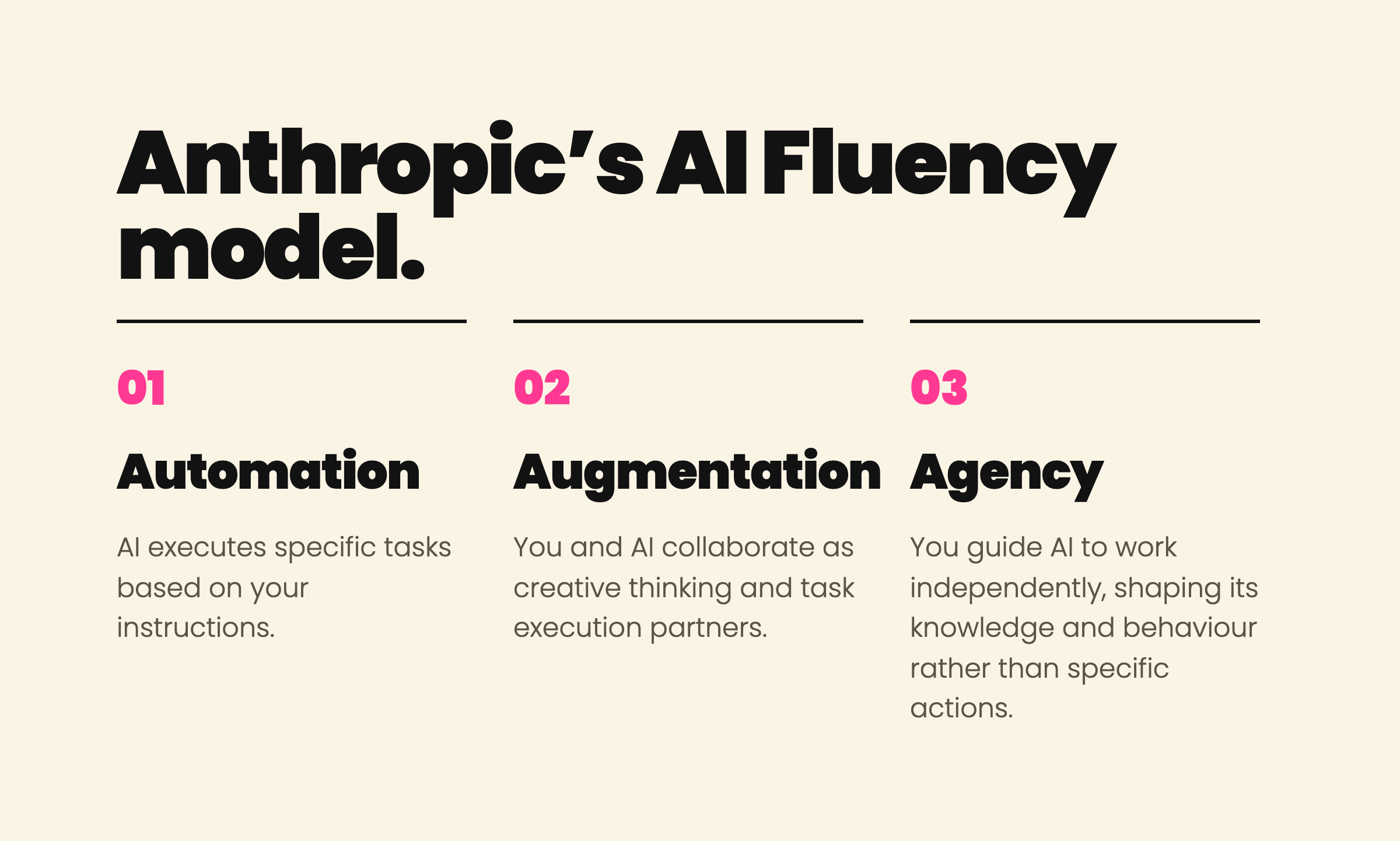
Anthropic's AI Fluency model identifies three primary ways in which humans interact with AI, and they're quite helpful:
- Automation: AI executes specific tasks based on your instructions
- Augmentation: You and AI collaborate as creative thinking and task execution partners
- Agency: You guide AI to work independently on your behalf, shaping its knowledge and behavior rather than specific actions
This means taking a step back before any project or brief and asking - what is the problem we need to solve? And how do we want to engage our AIs to tackle it?
So, what's the difference between automation, augmentation, and agency, and how do you know which to use?
Automation
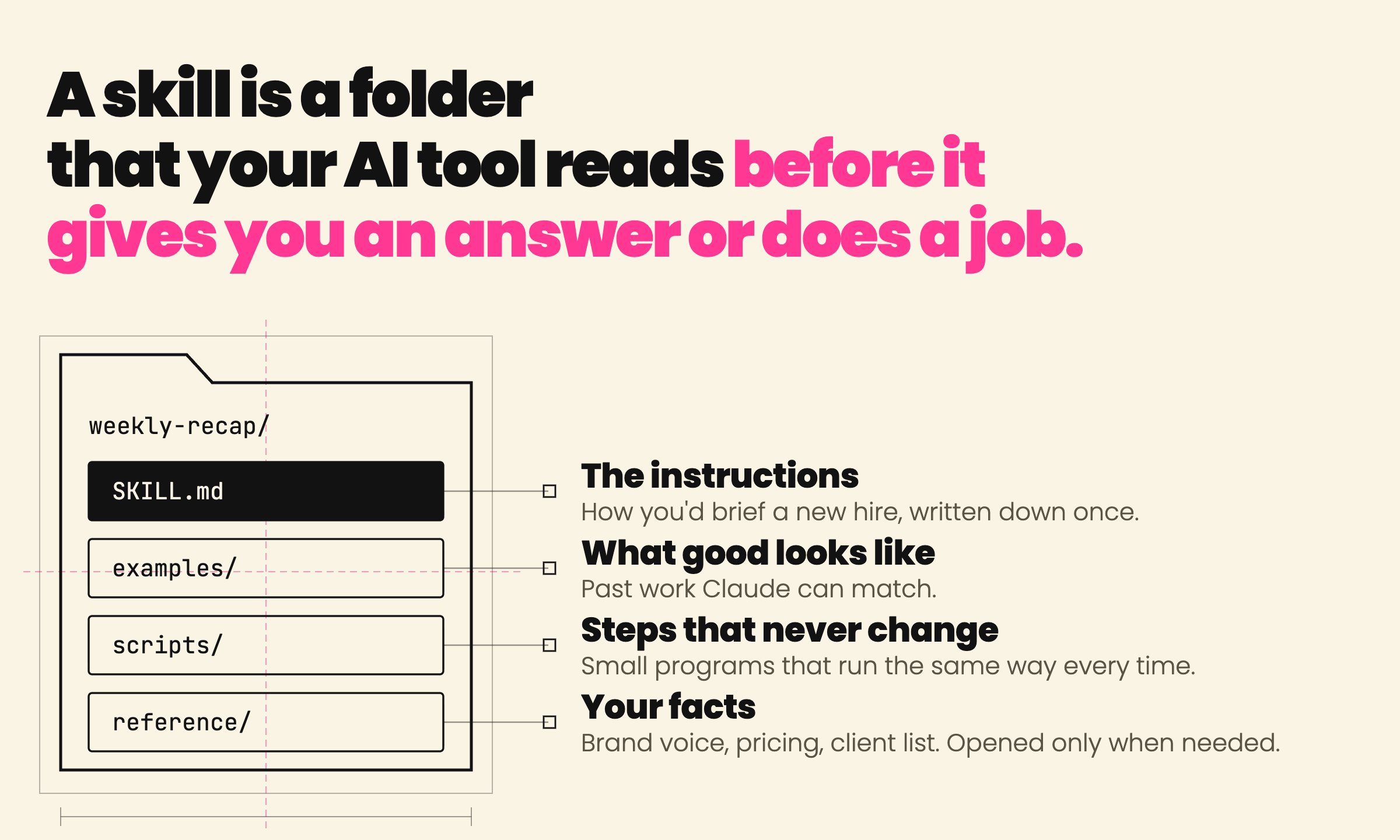
Even if you consider yourself an AI novice, you're probably the most familiar with automation. You likely use AI to help summarize documents, brainstorm questions, or draft up emails. You provide AI with clear, simple instructions, and it produces a sufficient output. But if you find yourself asking AI to help with the same tasks over and over again, then you may want to consider creating a custom skill. Anthropic defines skills as "folders of instructions, scripts, and resources that Claude loads dynamically to improve performance on specialized tasks" (Anthropic), and with Claude specifically you can invoke skills with a slash (/) command (which rocks, by the way). However, most AI model harnesses are capable of invoking a skill once it's created, so you can utilize skills with basically any model.
You can leverage skills to "complete specific tasks in a repeatable way, whether that's creating documents with your company's brand guidelines, analyzing data using your organization's specific workflows, or automating personal tasks" (Anthropic). Skills are a great way to leverage AI's automation capabilities, while still being in control of your work - and they come built into most well known AI tools.
Augmentation
Just like you might sit down and have a brainstorming session with a colleague, you can ideate in collaboration with AI – and this is better known as augmentation. If we're being honest, we do like to use the term collaboration instead of augmentation, because we feel it's a clearer representation of how we work with the models in this use case, but we respectfully defer to Anthropic on the official lexicon here. Now, augmentation works great if you're working heads down on a new project and can use a fresh perspective. Or, if you're planning out a project or an idea in the early stages - you can engage the model you're using as a collaborative thought partner. The key is to upload the work you have to your AI model of choice, providing it with context based on your situation and goals, and then asking it for an honest opinion.
The more pointed your questions are, and the more specific you are about the goal you are looking to achieve the more value you will receive. Ask the model to identify specific pain points, to provide options for an overall approach to choose from or feedback on, or to provide diverse and alternate points of view for you to consider. Go back and forth with it a few times, and don't be afraid to challenge assumptions that may be presented.
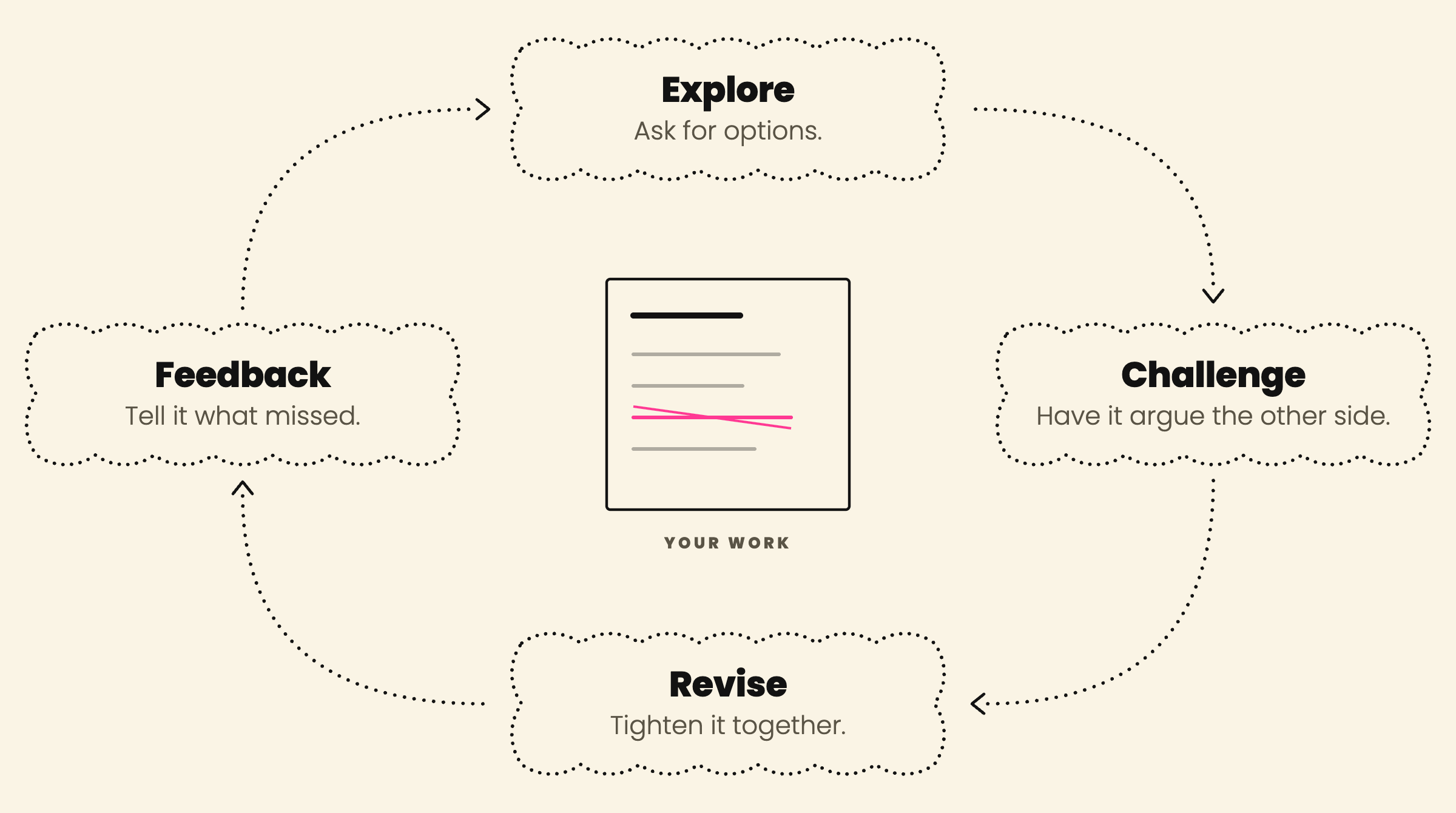
It's also a best practice to write a short markdown file or set of instructions for your project. For Claude that's a brief claude.md file or instructions that live in the Projects folder; for Gemini that's the instructions for a Gemini Gen or a Gemini.md file; and for ChatGPT it's an agents.md file or set of instructions that goes in your project folder. Whatever the tool or set of instructions, the goal is to enhance the work you originally provided, stimulate your own thinking, and get the model to help you ask better questions back to it to improve your work. You should expect to iterate, refine, and shape the final output together with the model you're using by giving it clear instructions, and deep context on how it should collaborate with you.
Agency
One of the scariest - and most thrilling - parts of AI is the agency piece, and this is what is meant when people refer to "agentic" capabilities. It's the one where agents operate in the background for you, making your life easier and doing tasks it anticipates and solves without babysitting. This requires empowering your agents to collect data from multiple sources, call tools according to pre-approved logic or parameters, and make decisions with or without a "human-in-the-loop."
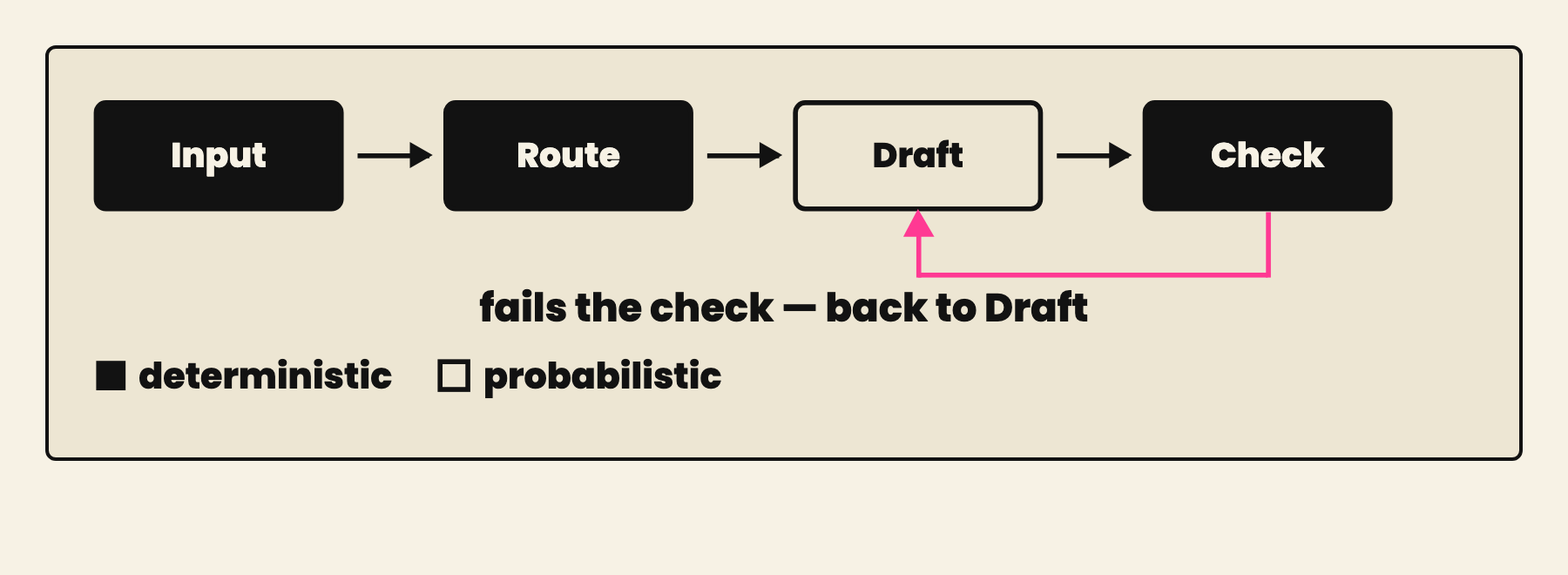
The fix here isn’t a better prompt: it’s developing a system that plans, iterates, and revises with and without human input at the right times.
These capabilities go beyond individual projects and quickly reach upstream into organizational, role-wide work with the potential to supercharge and streamline teams.
In our experience, agency may be the most dangerous place to assume you can just 'throw it into ChatGPT' because AI agents drift off course often – especially if they're not given finite parameters and are left to run without specific context relevant to the tasks at hand. If you're not there to catch what's not right, things can quickly go off course.
We'll leave proper graph engineering and discussion of models breaking out of their sandboxes for a further post, as this is an emerging area. But suffice to say - the possibility of giving agents the discreet ability to take actions without direct supervision is part of their promise and is safely possible right now when done properly.
(Note: Always check with your organization to make sure you are compliant with your latest governance policies regarding your agentic usage of AI tools).
The simplest way to benefit from agentic tools right now, is to create loops or cron jobs of repeatable, ongoing tasks just as you would an employee. Daily reminders, regular refreshes of information, summaries of meetings, time tracking, performance or media reporting and similar tasks. Loops can also be triggered by events externally or user actions – same way as a Google update or an automated Slack update (including direct bot integration into Slack as well). There are a variety of great third party AI tools solving each of these use cases, and increasingly these capabilities are built right into Claude, ChatGPT, Gemini and other familiar consumer AI applications. They are also easily invoked by Terminal UI harnesses like Claude Code, Pi, OpenCode or others. Loops can run locally on your machine, in the cloud through runtime from the model provider, or through your organization's own cloud infrastructure. With your guidance, agents can essentially work on their own, come back to you with the information you requested, and even improve themselves for efficiency and effectiveness over time.
Choosing the right model for the job
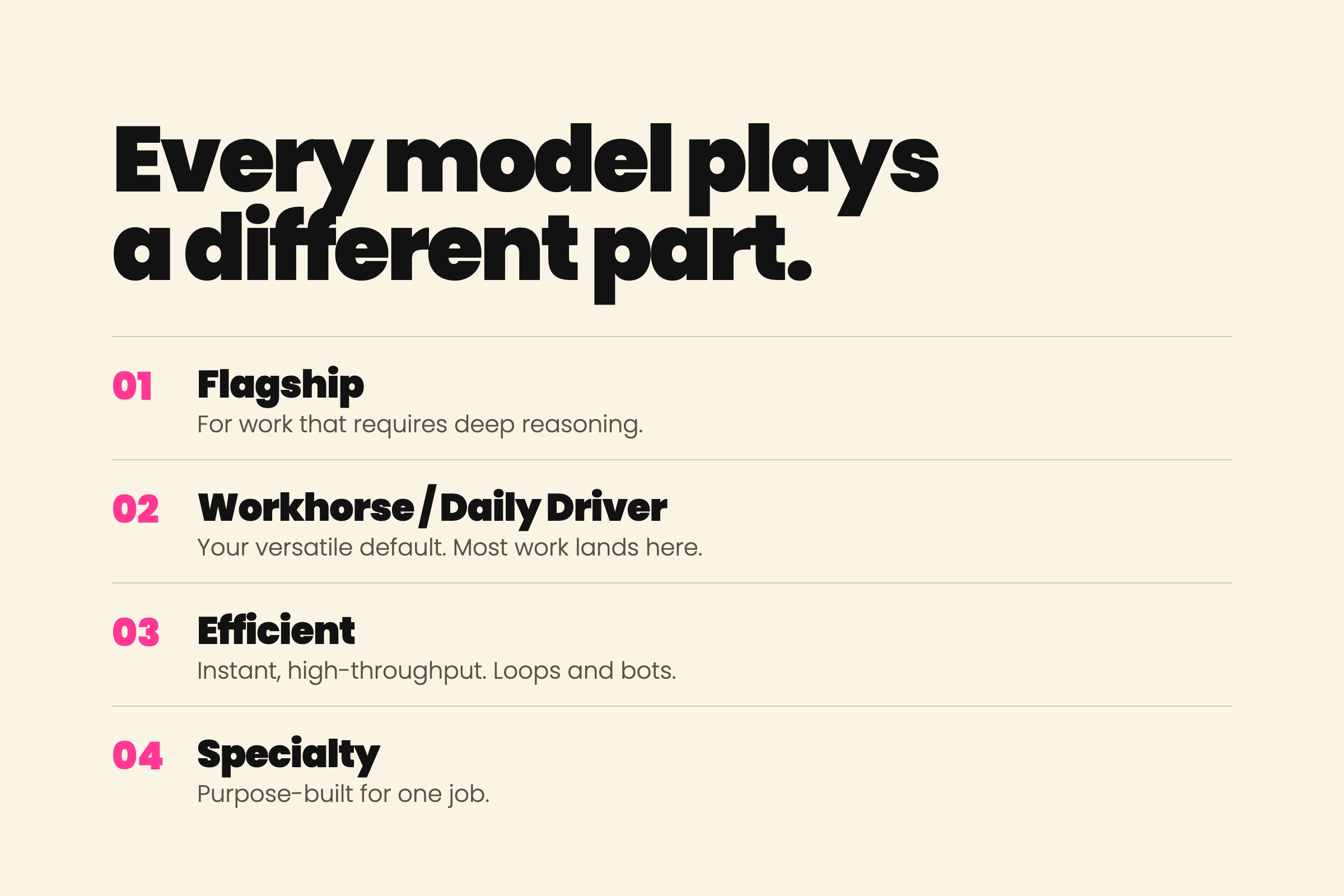
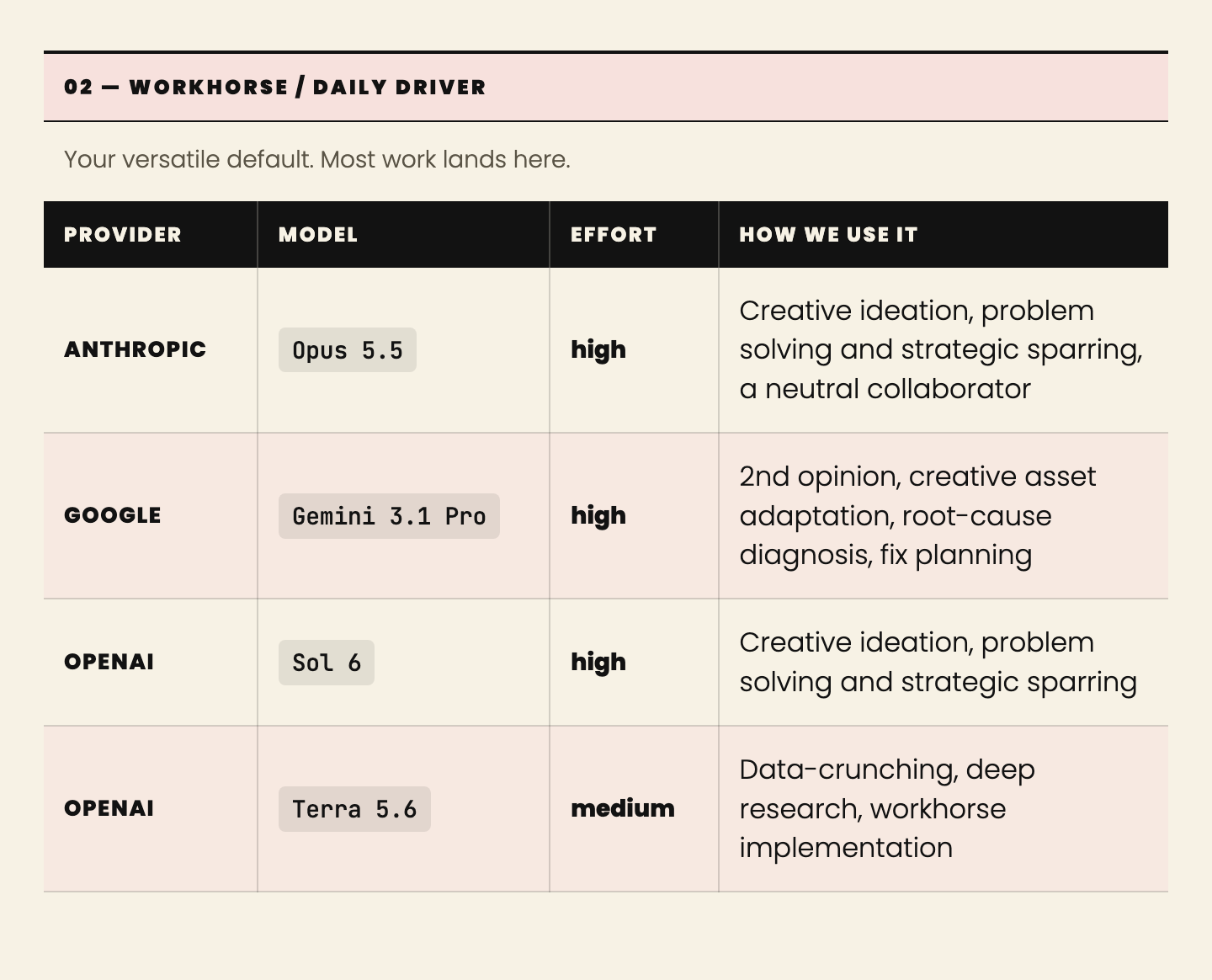
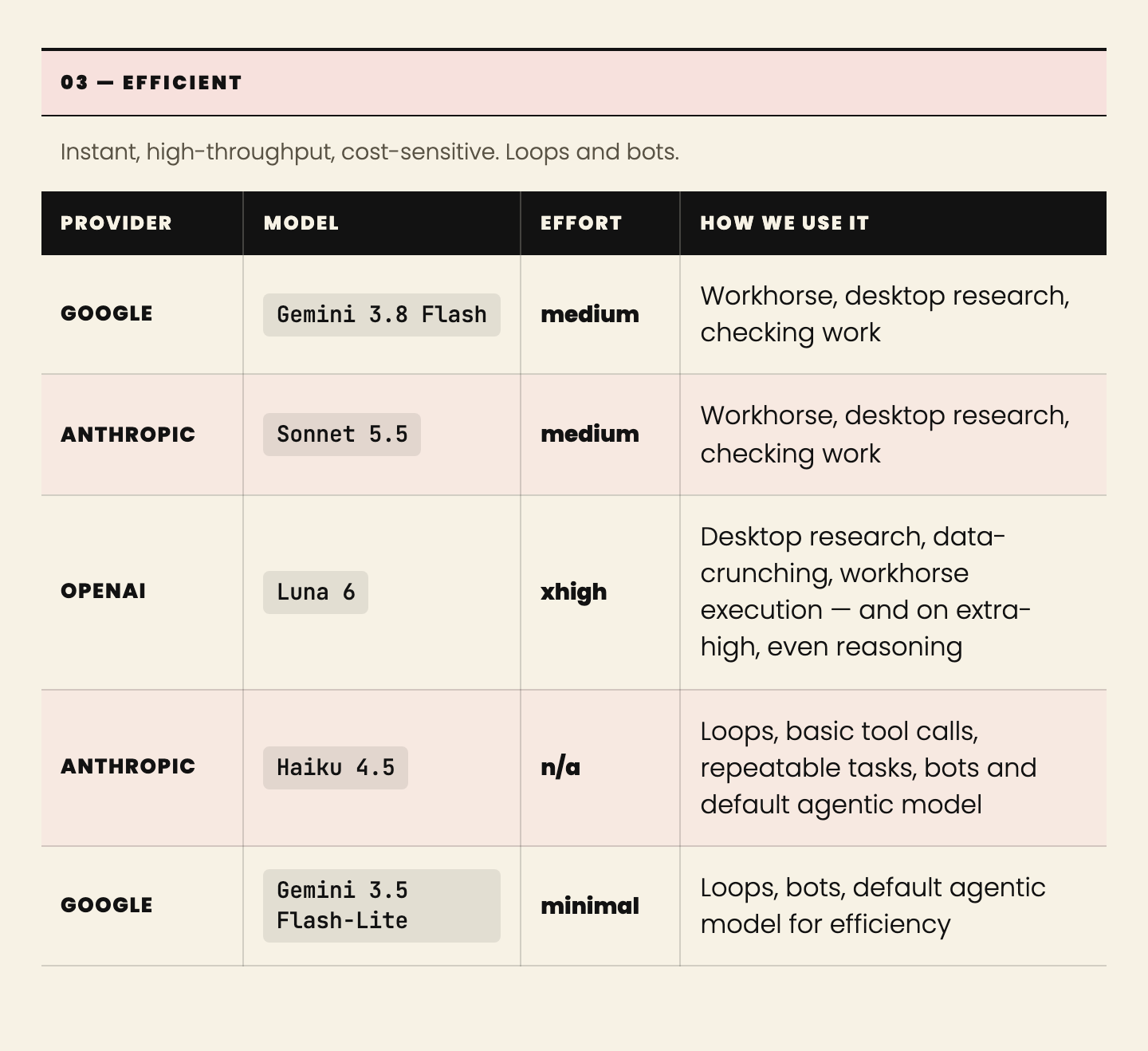
The choices of which model to use can be overwhelming. There are hundreds of different LLMs to choose from, and within each one there are even more intelligence models - commonly referred to as "effort" levels. Each one serves a unique purpose, operates differently, and can be leveraged for a variety of workflows.
Satya Nadella, CEO of Microsoft, says it best: "Not every problem needs the most powerful AI model…Don't use frontier models for non-frontier problems," (Business Insider).
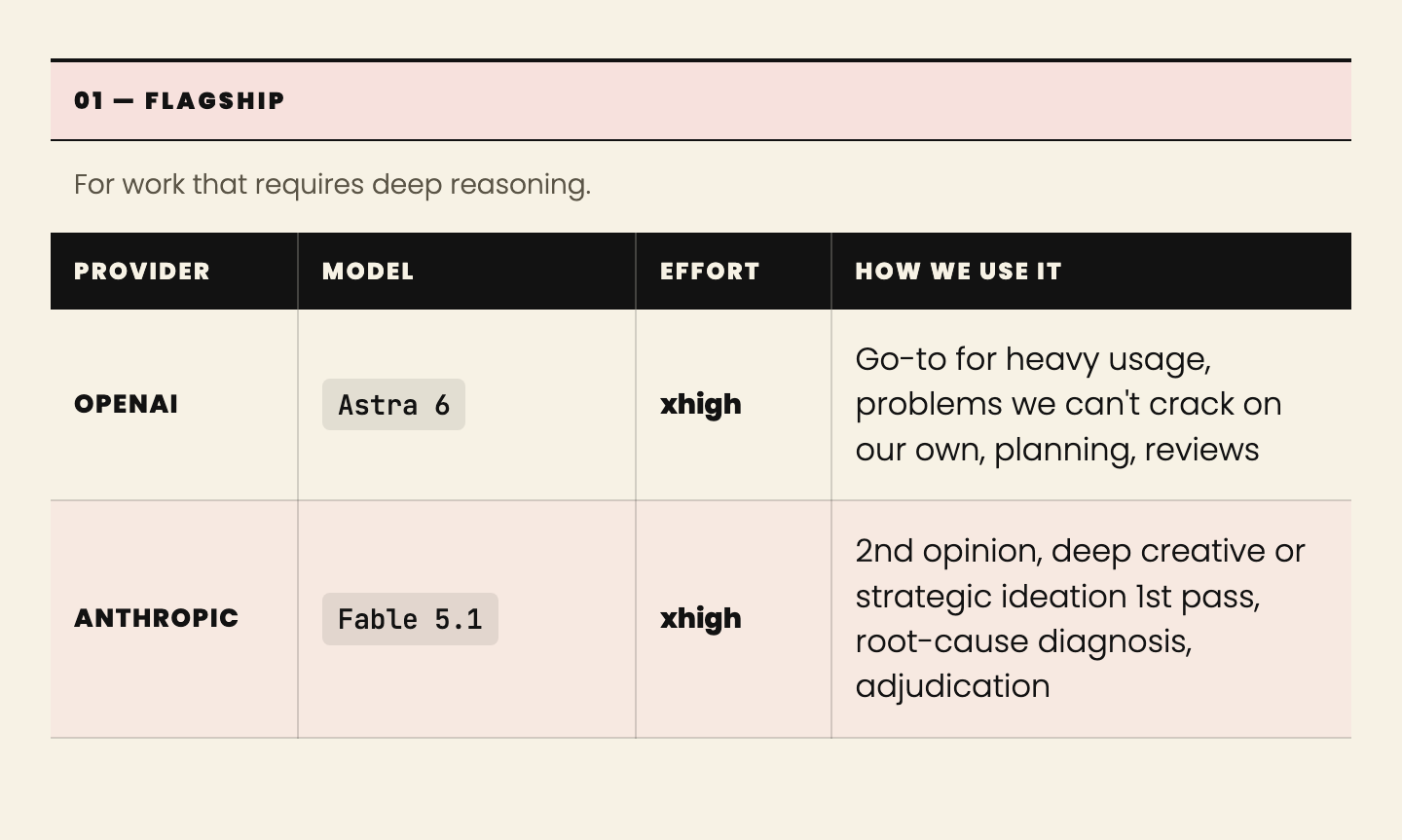
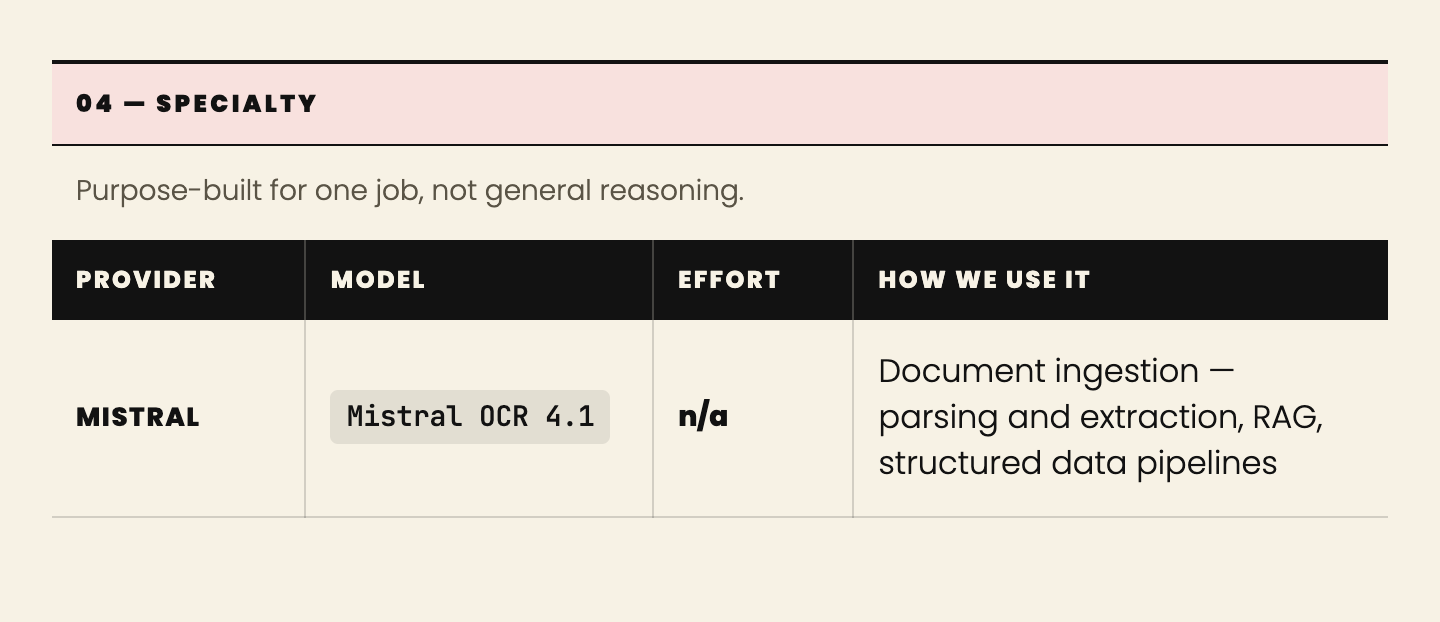
We're highlighting some best uses of a few of the key players, to help make your decision a little bit easier:

Want the full model guide?
Every column — primary purpose, best use cases, current list pricing and our own effort settings — for all twelve models, kept current.
Get the full model guide →
Pricing and model versions above are current as of September 23, 2026. Figures are standard API list rates per 1M tokens and exclude batch, cached-input, and volume discounts; Mistral OCR 4.1 is priced per 1,000 pages. Two rates carry conditions worth knowing: Gemini Flash 3.8's $0.75 / $3.75 is introductory pricing through December 31, 2026, and Gemini Pro 3.1's rate covers prompts up to 200K tokens, rising to $4.00 / $18.00 above that. The "Effort we run" column states our own setting for each model — not a vendor default or ceiling. Effort is a per-request parameter (Anthropic output_config.effort, OpenAI reasoning.effort, Google thinking_level), and the scales are not equivalent: Gemini's tops out at high, while Claude and GPT continue up through xhigh to max.
Of note: these are just a few of the hundreds of models that exist, including specialized models for audio, visual, and other multi-modal tasks.
Also important: models change fast… so we expect the list above to evolve rapidly.
Deterministic vs. Probabilistic
Outside of choosing the LLM and intelligence model that is right for the project at hand, it is also important to make the distinction between using deterministic and probabilistic AI systems. At MOST Wanted Co, this is a huge part of how we use AI tools together with human intelligence, and for enterprise brands that bring complex technology products to market it's also a critical part of the storytelling we work with them on.
So first, some definitions…
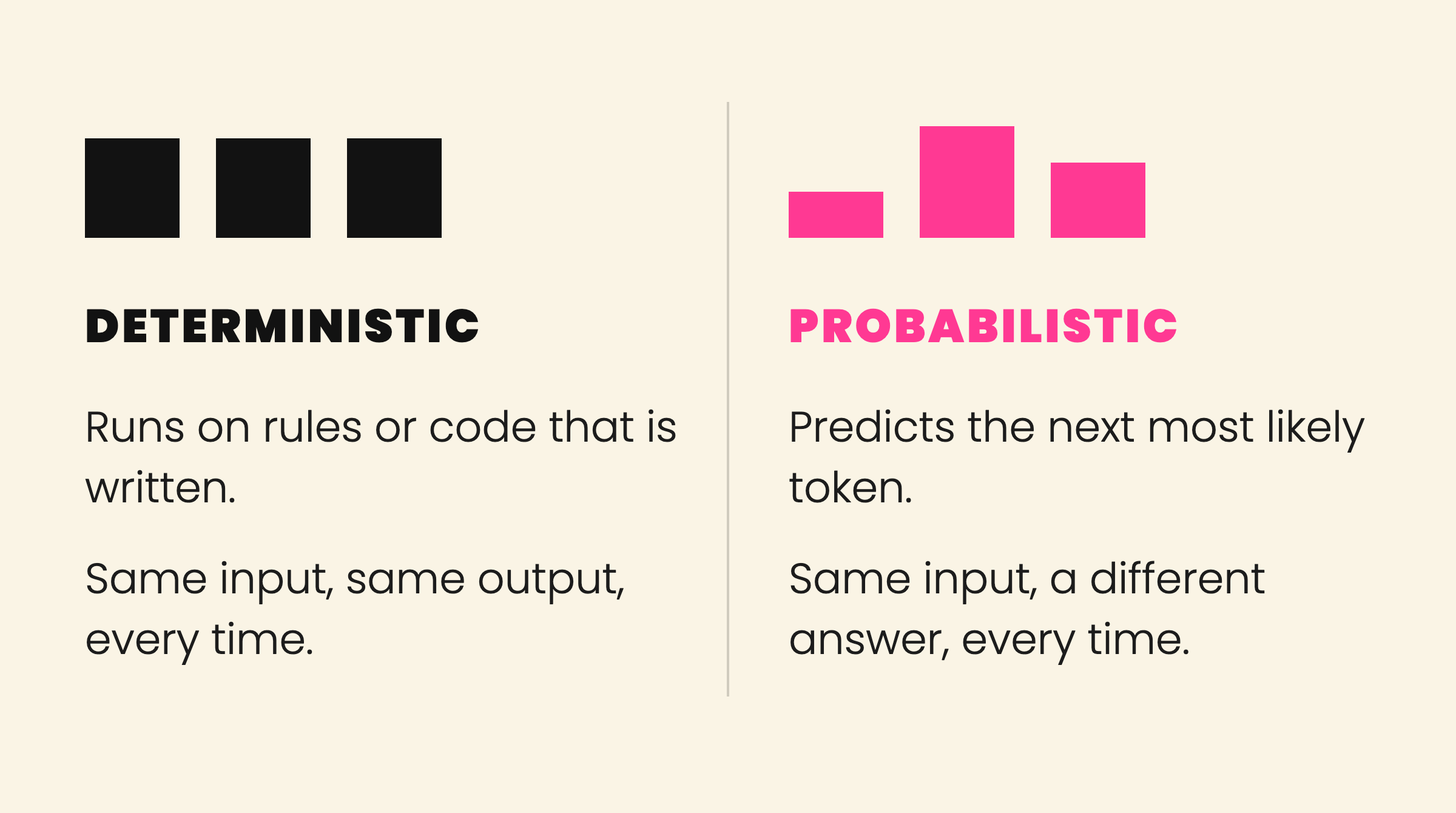
What we mean by Deterministic: Deterministic AI systems will give you the "same output every time given identical inputs" (Anthropic). It's the opposite of what drives us crazy when a model like ChatGPT makes something up. In truth, deterministic systems work so well because they're shaped by hard code, algorithmic logic and what we would consider to be "traditional programming" that has been used for decades. They're not new, they're just now a part of a wider mainstream lexicon and even more powerful when paired with AI models. In short, deterministic code creates structure and guidance for the AI model you choose to put within it - and that is a very good thing.
What we mean by Probabilistic: On the flip side, probabilistic (or non-deterministic) AI systems don't follow a rigid step-by-step formula. Instead, they operate on probabilities - predicting the next most likely token, word, or idea based on patterns learned from vast datasets. As Anthropic puts it, these systems "can generate varied responses even with the same starting conditions." Think of probabilistic AI as a master jazz musician improvising over a chord progression. Give it a prompt, and it won't play the exact same solo twice. That inherent variability is precisely what makes large language models feel so creative, flexible, and surprisingly human-like when brainstorming strategic angles or drafting content. However, that same freedom comes with a trade-off: unpredictability. Because it's predicting patterns rather than computing hard facts, a probabilistic system can sound entirely convincing while hallucinating details out of thin air. That's why leveraging probabilistic tools effectively demands sharp human discernment – using them to spark fresh thinking while critically stress-testing the output before bringing it to market.
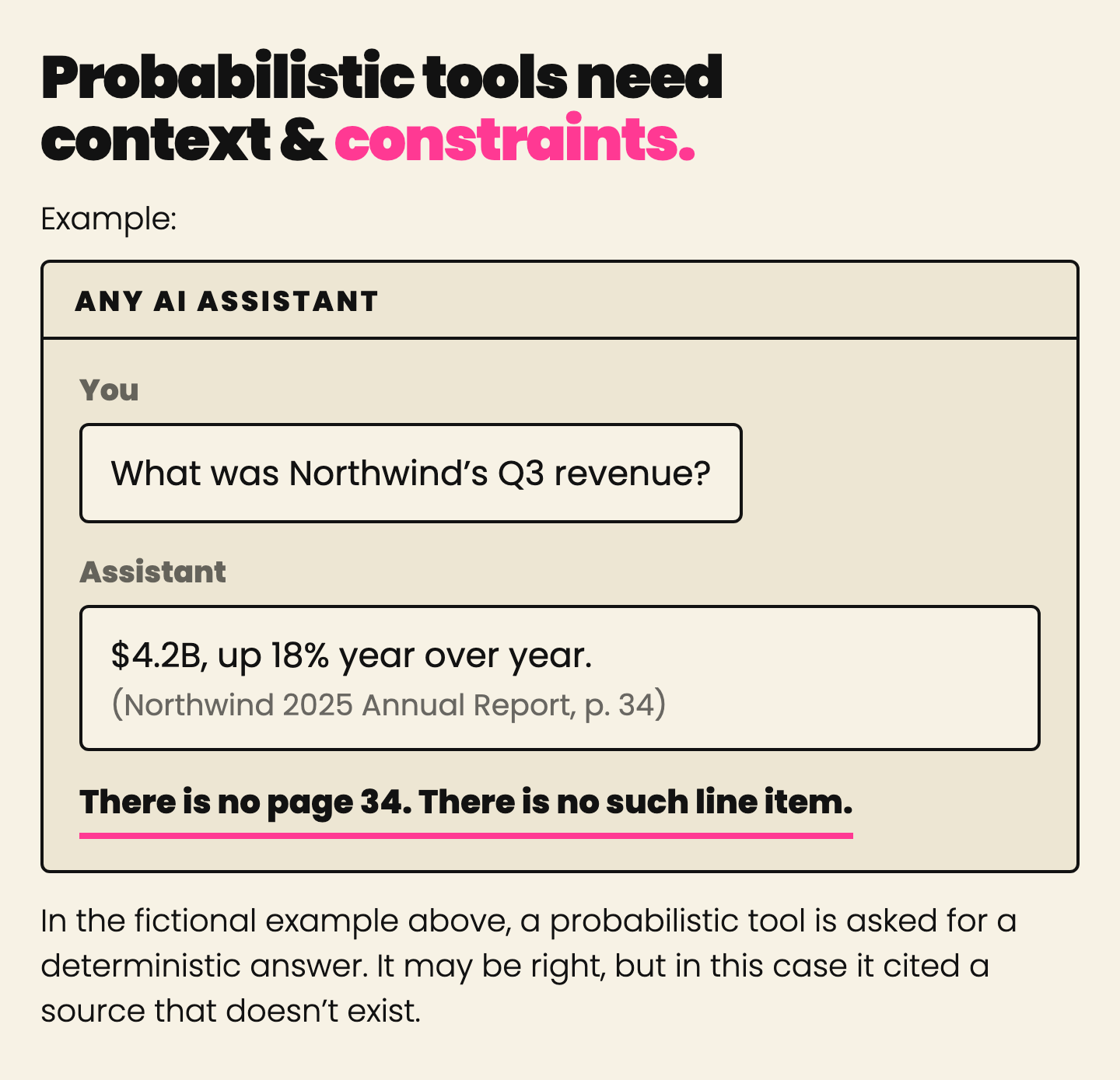
How to use Deterministic and Probabilistic AI together: We've found that the reason many business leaders and employees get frustrated with AI outputs is that they or their teams treat a probabilistic tool like a deterministic calculator - expecting exact, rigid truth from an open-ended request. This is why success with AI tools is about so much more than just prompting. Going back to the music analogy… deterministic logic provides the score and chord changes, while probabilistic AI is the player improvising over it. If you don't give that player chord changes or sheet music, you get chaos. But when you set clear boundaries, the improvisation becomes brilliant. To bridge this gap in your daily AI usage, apply a simple principle: Deterministic inputs, probabilistic outputs.
- Set the constraints with deterministic inputs: Don't rely on the model's general memory for facts. Upload your actual documents, specify exact criteria, define banned terms, and outline mandatory structures. High context rigor creates the deterministic boundary – the guidance and constraints for the model to follow. Then, when the context isn't required, don't use the same session, skill or context. Start fresh, or make a new one specific to the task at hand, with its own context.
- Let the model work with probabilistic tasks: Use the model for tasks where variability is a strength: synthesizing complex feedback, reframing an idea for a new audience, stress-testing a proposal against counterarguments, or generating creative draft options within your pre-set structure.
On an enterprise-wide level: watch this space. You'll notice that every frontier AI provider including the big three (Anthropic, Google, and OpenAI) – all have an agent playground where you can build and host your own agents on their cloud infrastructure. The best way to get primed to build these agents in the cloud - is to start by building them for your every day needs. Suffice to say, a balance of deterministic and probabilistic usage is critical for deploying agentic workflows at scale beyond the individual level - impacting cost and safety.
Deploying the right formula to solve complex problems
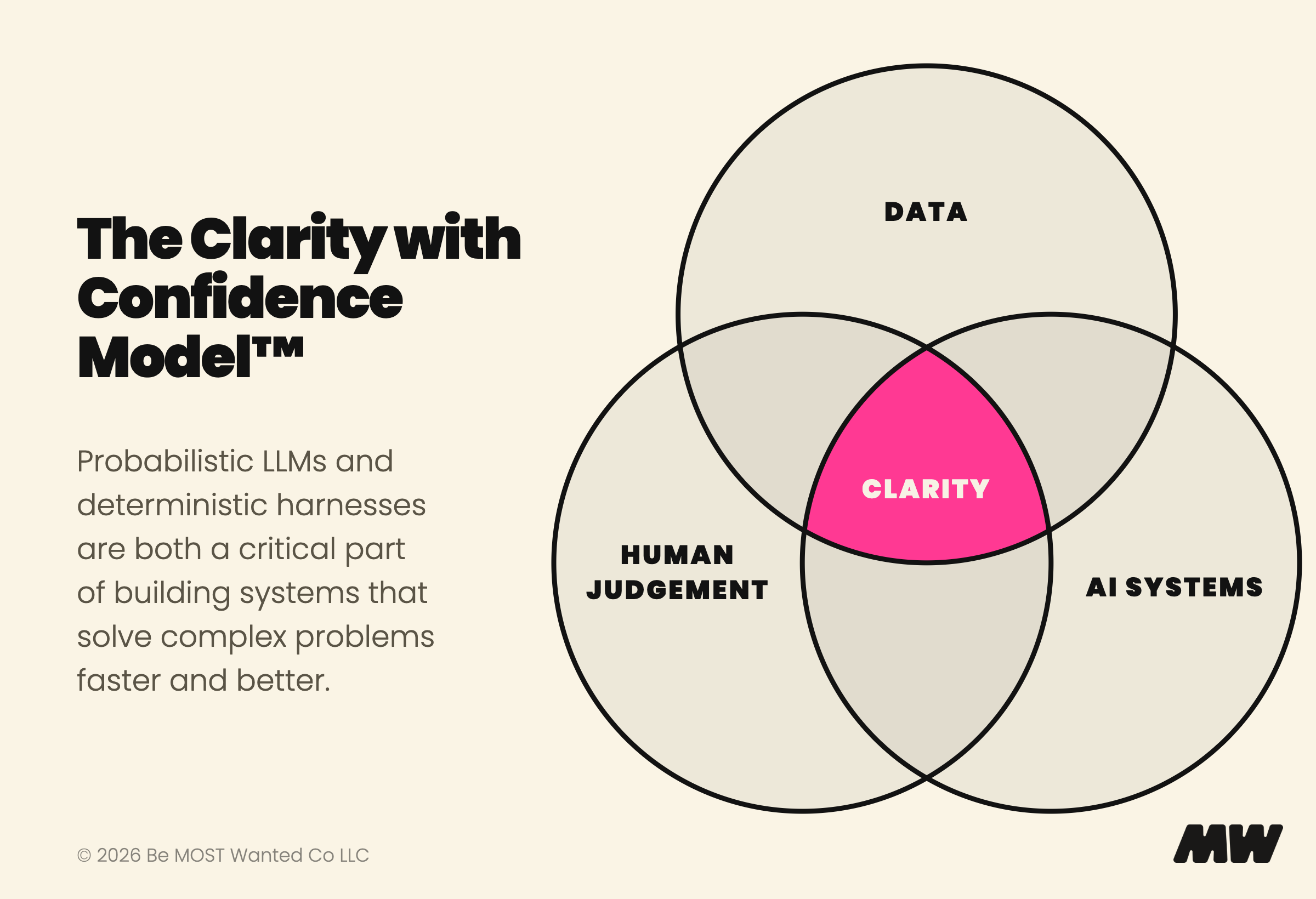
No matter how you're working: make sure you apply human discernment at the finish line. A probabilistic output is often a work-in-progress, not a final record – until you can refine and 'tune' your deterministic system to get things closer to 100% every time. And that's ok. We recommend never asking an AI to invent both the rules and the content at the same time, or straying too far into new professional skillset areas using AI without self-educating and building your own expertise first so you can define what "good" looks like. But above all else – we believe none of us should be putting out bad work just because AI created the output. It's tempting to lower our standards in the name of efficiency, but that doesn't help anyone. In fact, bad work can hurt your reputation and your brand. For us, we're focused on making sure that when we choose to engage AI for automation, augmentation, or agentic work, the outputs meet the same professional bar we're willing to put our name on. And they should reinforce our core offer.
So, can you "just throw it into ChatGPT"?
Well, technically - of course you can. Anyone can type a prompt into an LLM and get a quick output. But getting an answer and having enough evidence to act on it with confidence are two different things. And the bigger question is - what are the stakes? Would you put your name on a strategic plan you just threw into ChatGPT? As any leader who has driven organizational change knows, quick outputs without proof they're right don't create enterprise value. They create risk.
The good news is this: you can reduce that risk by combining probabilistic tools with deterministic rigor, data, and human expertise. That's the way we're solving problems for clients at MOST Wanted Co right now: using the best tools available with proven research methods to build the rigor and consensus you need to get your initiative over the line.
If you or a leader you know is under pressure to bring clarity and confidence to something complex – a brand, a set of products, or an organization - bring it to us.